Home · History
Chapter II
A short history
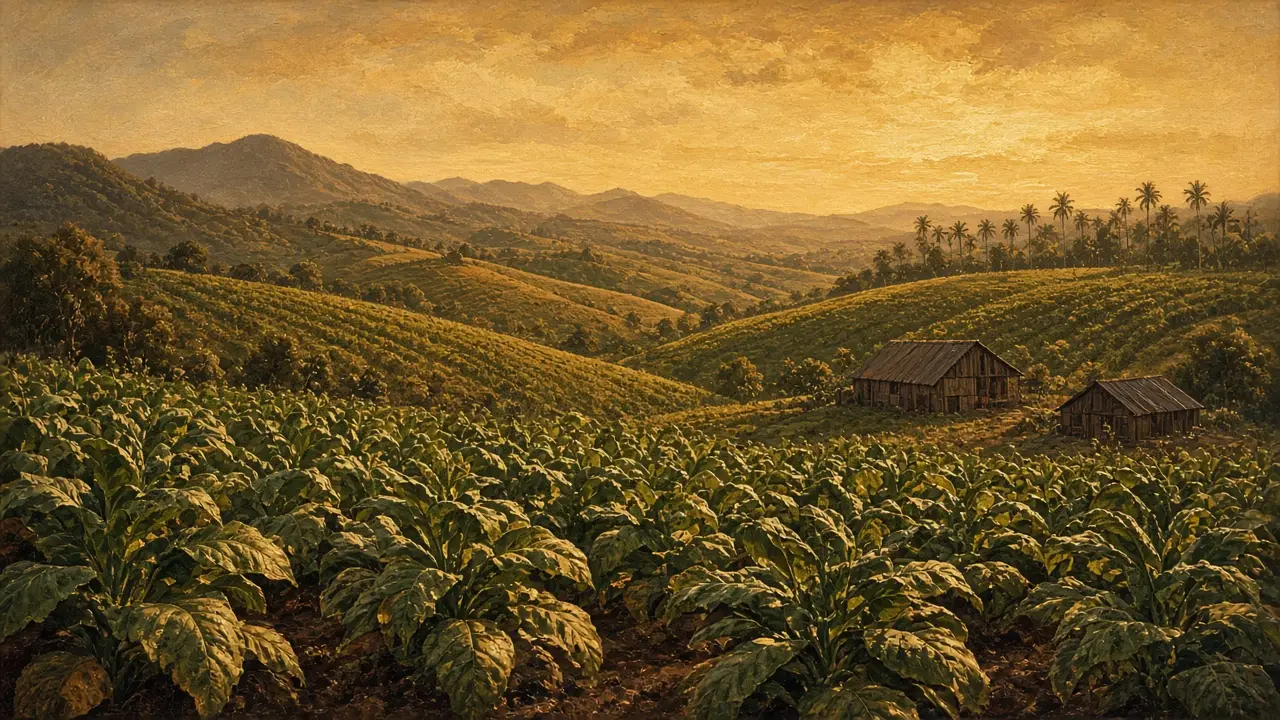
Tobacco is native to the Americas. After the fifteenth and sixteenth centuries it became an Atlantic commodity. The cigar as a whole-leaf roll took professional form in Cuba, in Seville, and later in other ports.
Early records
Colonial journals describe Taíno and other peoples smoking leaves or tubes. Those notes are European and incomplete, but they show tobacco had social and ritual uses long before brand bands.
Spain first processed leaf in Europe. Western Cuba’s Vuelta Abajo later proved especially suited to high-grade leaf, and Havana became a rolling and export center.
Nineteenth-century Havana
Many names still on boxes were born in that century: Partagás, H. Upmann, Romeo y Julieta. Factories, export houses, bands, cedar boxes, and vitola names became a shared language.
Planting also spread to the Philippines, Indonesia, and the Connecticut River Valley. Wrapper trade was international early. “A Cuban cigar” and “a cigar made only of Cuban leaf” have not always meant the same thing.
After 1959
The Cuban Revolution nationalized private tobacco firms. Families left with seeds, methods, and brand memories for the Canary Islands, the Dominican Republic, Nicaragua, Honduras, and the United States. Later U.S. trade limits kept Havana cigars out of the American market for decades and helped New World factories grow.
Cuban exports now run through a state-linked system often associated with the Habanos name. Outside the island, family factories and large groups sit side by side. The same brand name can live two lives. Read the label.
Now
Since the 1990s, boutique factories, farm-owned brands, infused cigars, and very large ring gauges have become talking points. Magazines and social media changed collecting. In the field, seedlings, harvest, cure, and fermentation still take months and years.
Related chapters
Cuba
Cuban growing districts, the state industry after 1959, and the usual character of Havana brands.
How a cigar is made
A map of growing, harvesting, curing, fermentation, sorting, rolling, and aging from field to cedar box.
What is a cigar
How a cigar differs from a cigarette, what long-filler handmade means, and how to read wrapper, size, origin, and strength.