Home · Wrappers
Chapter VI
Wrapper colors and types
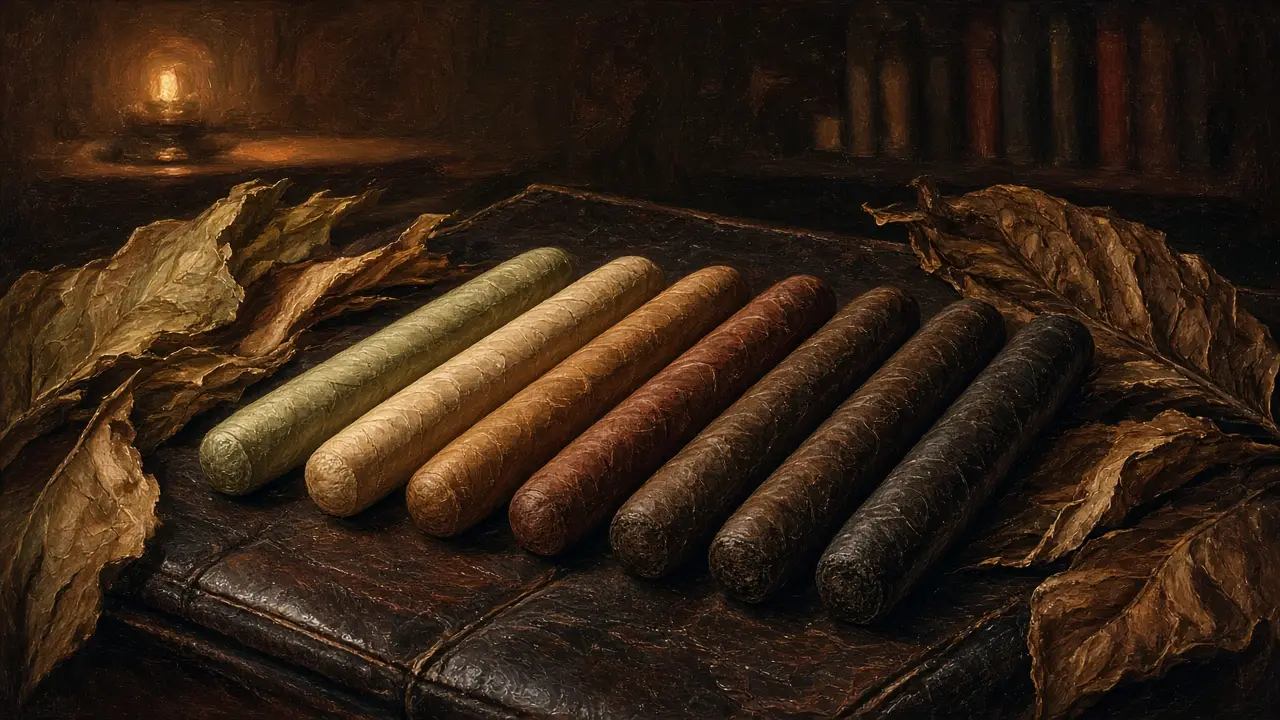
Color is first a record of ripeness and fermentation, then a flavor clue. Darker is not better. It is usually sweeter, thicker, and sometimes stronger. A pale wrapper can be delicate or thin—leaf quality decides.
A common color ladder
| Name | Look | Often described as |
|---|---|---|
| Candela / Double Claro | Green-gold | Fixed early; herbal, grassy; less common now |
| Claro | Light tan | Shade leaf; cream and nut |
| Colorado Claro | Light brown | Wood and mild spice |
| Colorado | Red-brown | Oilier; more spice |
| Colorado Maduro | Deep reddish brown | Cocoa, sweet earth |
| Maduro | Chocolate brown | Longer fermentation; sweet, thick |
| Oscuro | Near black | Very dark fermentation; sweet-bitter |
Names from seed or country
- Connecticut Shade — thin, pale, costly; grown under cloth in the U.S. or Ecuador.
- Connecticut Broadleaf — thicker; often used as maduro.
- Habano — Cuban-seed sun leaf grown in several countries; spicy and oily.
- Corojo — an old Cuban wrapper line; bright and peppery.
- Criollo — another old line; often gentler or sweeter.
- San Andrés — Mexican; dark; cocoa and earth; a frequent maduro.
- Cameroon — fine tooth, sweet spice; supply is uneven.
- Sumatra / Ecuador Sumatra — Indonesian seed, often grown in Ecuador.
- Brazil (Mata Fina and others) — sweet earth on some lines.
Seed, soil, and fermentation all act. “Nicaraguan Habano” is not Cuban leaf. It is a relative in style.
Related chapters
Cigar anatomy
Wrapper, binder, filler, cap, foot, band, and ash: the structure of a cigar from the outside in.
Growing and harvest
Volado, seco, and ligero; shade versus sun; soil and climate; why one plant can feed three roles in a blend.
Strength: mild to full
How strength, body, and flavor intensity differ, and how to choose a first cigar without getting sick.