Home · What is a cigar
Chapter I
What is a cigar
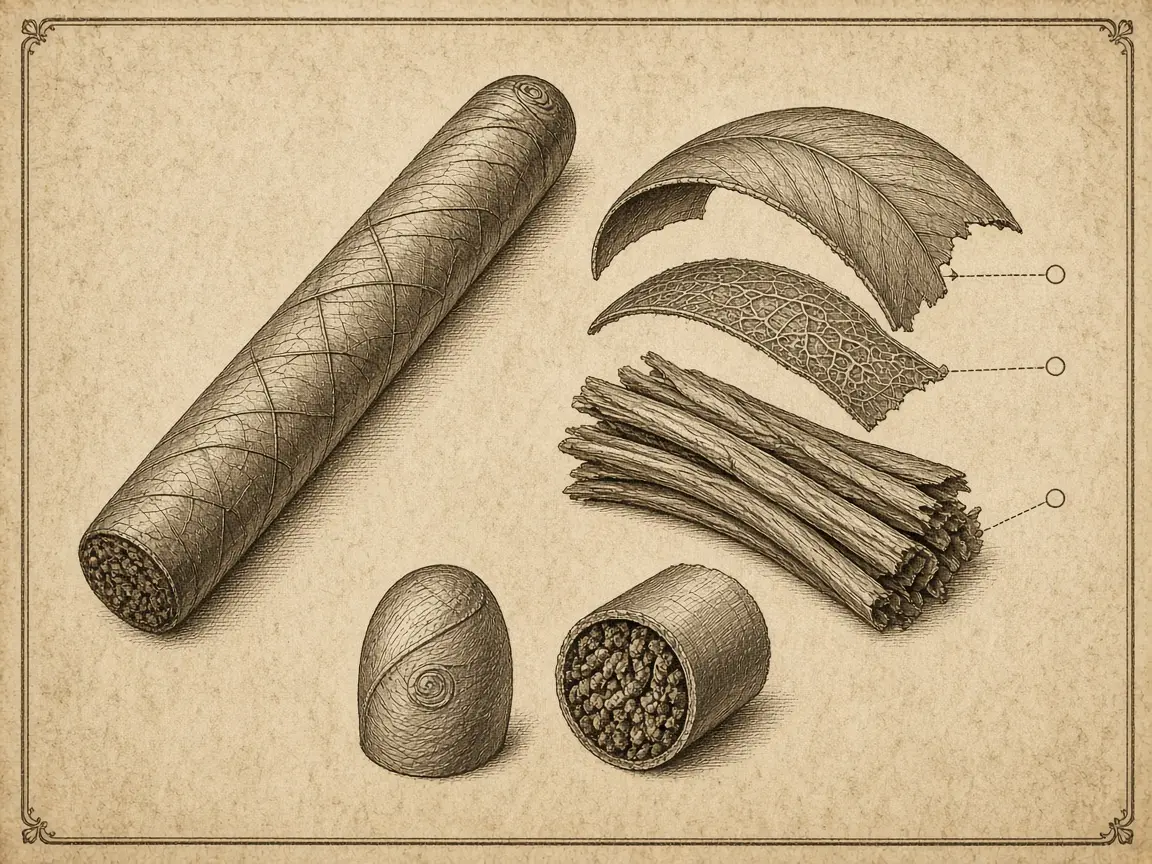
A cigar is fermented tobacco leaves rolled so they can burn on their own. Unlike a factory cigarette, a traditional premium cigar has no paper tube and no filter. The smoke travels through leaf, not through reconstituted sheet and additives designed for a two-minute habit.
A typical long-filler handmade cigar has three layers: the wrapper, the binder, and the filler. Long filler uses whole leaves laid lengthwise. Short filler uses scraps. Short filler is cheaper and burns faster; it rarely develops the same sequence of flavors.
Not a large cigarette
Cigarettes use cut tobacco, paper, and usually a filter. Many also use expanded leaf and flavorings. A large cigar can occupy an hour. Nicotine and tar are still there. “I do not inhale” is not a safety claim.
Cigarillos sit closer to cigarette rhythm. This almanac is about cigars that need a cut, a careful light, and humid storage.
How it burns
You toast the foot and draw heat through unburnt leaf. Oil, fermentation, and how tightly the bunch was made decide whether the draw is open, whether the ash holds, and whether the cigar goes out. Too loose runs hot; too tight plugs.
How to read one cigar
- Origin and brand: see regions and the brand register.
- Wrapper color and seed type: see wrappers.
- Vitola: length and ring gauge change time and the wrapper-to-filler ratio; see shapes.
- Strength: body and nicotine load, not a quality score; see strength.
Related chapters
Cigar anatomy
Wrapper, binder, filler, cap, foot, band, and ash: the structure of a cigar from the outside in.
How a cigar is made
A map of growing, harvesting, curing, fermentation, sorting, rolling, and aging from field to cedar box.
A short history
From Caribbean tobacco rites and colonial trade to Havana’s brand century and the rise of New World factories after 1959.
Shapes, vitolas, and ring gauge
What a vitola is, how ring gauge is measured, and typical sizes for Corona, Robusto, Churchill, Torpedo, and Perfecto.