
Making · Bench
Rolling
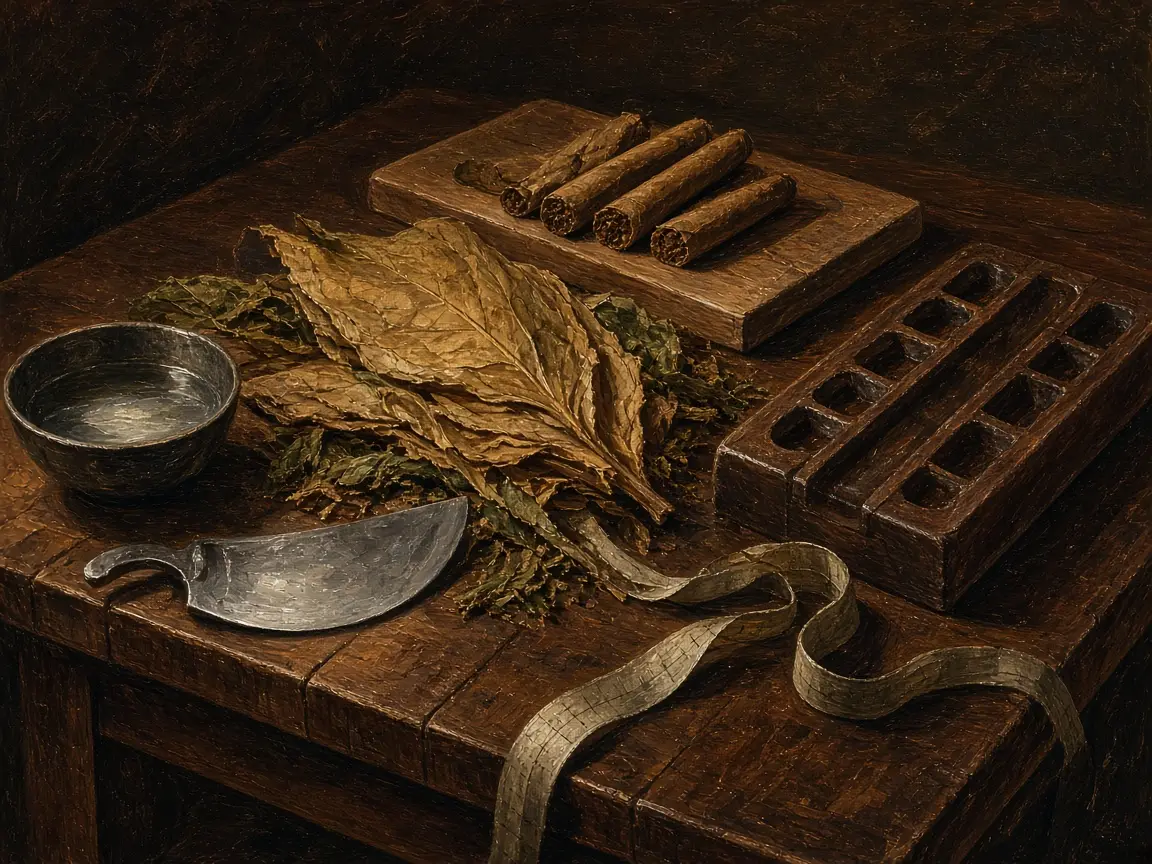
Cuban tradition often splits bunching and wrapping between two people. Many New World factories let one person do both. The tools stay simple: a half-moon chaveta, a wooden mold, a board, and a little water.
Three steps
- Bunch. Volado, seco, and ligero are arranged. Folds may be accordion, book, or the slower tubular entubado. Air needs a path that is not a hollow core.
- Binder. The binder holds the bunch. It sits in a mold to take shape, often for about an hour.
- Wrapper and cap. The show leaf goes on last. Small rounds of leaf close the head. A Cuban triple cap looks like a thin collar at the seam.
Machine and half-handmade
Machines make neat short-filler cigars quickly. Half-handmade work (machine bunch, hand wrap) sits in the middle. “Handmade” is not a moral grade: poor handwork is uneven; a good machine cigar can be honest daily smoke. Figurados and fine layering still belong to the bench.
Inspection
Weight, draw, holes, and the cap are checked. Some factories use a vacuum test. Failed cigars are stripped or downgraded. That is why two boxes of the same size can still feel slightly different.
Related chapters
Cigar anatomy
Wrapper, binder, filler, cap, foot, band, and ash: the structure of a cigar from the outside in.
Shapes, vitolas, and ring gauge
What a vitola is, how ring gauge is measured, and typical sizes for Corona, Robusto, Churchill, Torpedo, and Perfecto.
Aging
Why finished cigars rest in cedar, and what home aging can and cannot do.